

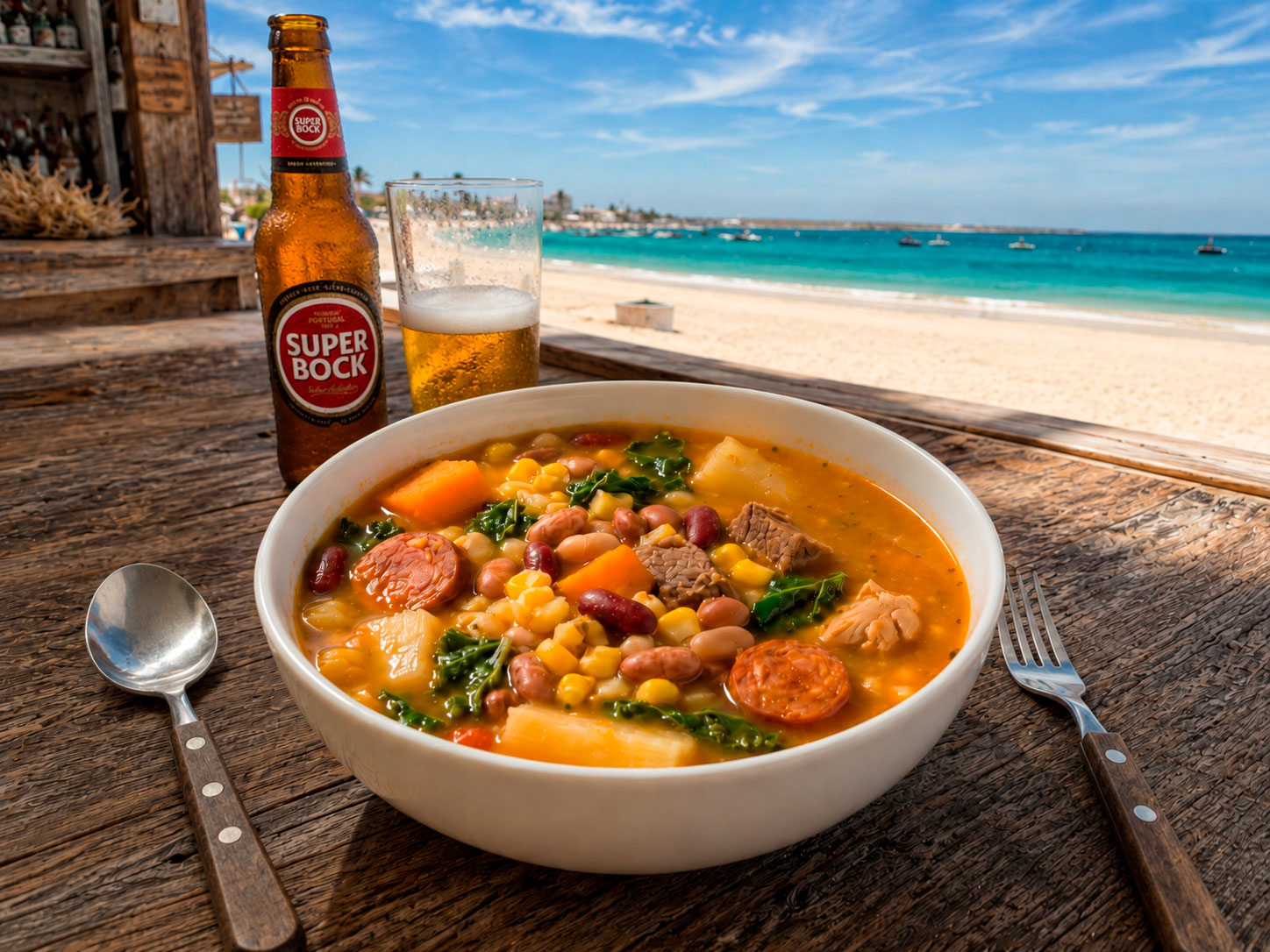
Food in Sal is fairly easy to understand once you arrive with the right expectations.
If you are expecting every meal to become a major gastronomic event, the island may disappoint you occasionally. If you arrive with curiosity, a little judgement and a willingness to appreciate simple food done well, you will probably eat perfectly well.
It is worth being clear from the beginning: Sal is not primarily a food destination. Most people do not travel here for haute cuisine, tasting menus or some grand culinary revelation.
But that does not mean the food is poor or uninteresting. What you find is a practical mix of Cape Verdean dishes, grilled fish, seafood, Portuguese influence, international restaurants and menus designed for tourists. In Santa Maria especially, there is enough variety to avoid eating the same thing every day.
Do not expect a culinary masterpiece on every corner
Islands tend to create certain expectations. Visitors see the ocean, fishing boats and palm-fringed terraces and begin imagining that every restaurant must serve extraordinary seafood prepared according to some ancient local secret.
Reality is usually less cinematic.
In Sal, you can eat well and occasionally very well. But the experience depends heavily on where you choose to eat, what you order and how much the restaurant relies on its location rather than its kitchen.
Some places offer genuinely good food. Others are pleasant but forgettable. A few are mainly selling a view, a terrace and the convenience of being surrounded by tourists.
The useful conclusion is simple: quality varies, and appearances do not always tell you much.
Simple food often works best
Many of the most satisfying meals in Sal are not particularly elaborate.
Grilled fish, roast chicken, seafood rice, stews, cachupa and daily specials often make more sense than dishes trying too hard to appear sophisticated.
This style of food suits the island. The appeal usually comes from fresh ingredients, familiar flavours, generous portions and straightforward cooking rather than technical presentation.
That does not mean every simple restaurant is automatically excellent. It simply means that in Sal, the dish that sounds least ambitious may sometimes be the one you remember most positively.
Cachupa is worth trying without turning it into a ceremony
If one dish represents Cape Verdean cooking more than any other, it is cachupa.
It is a slow-cooked dish traditionally made with corn, beans and other ingredients that vary depending on the recipe, the island and the person preparing it.
Is it worth trying? Absolutely.
Will everyone love it? Probably not.
If you enjoy hearty stews, legumes, dense textures and dishes that feel substantial rather than light, you are more likely to appreciate it. If your taste leans towards fresher or more delicate food, you may find it interesting without wanting to order it repeatedly.
That is perfectly reasonable. Cachupa is an important part of Cape Verdean food culture, but eating it does not need to become a compulsory spiritual experience.
Fish and seafood are important, but the ocean does not guarantee quality
Fish naturally plays a major role on an Atlantic island, and many restaurants serve grilled fish, tuna, octopus, lobster and other seafood.
However, being close to the sea does not automatically mean every plate will be fresh, perfectly cooked or good value.
Some restaurants handle seafood very well. Others depend more on the location, the sea view or the assumption that visitors will order fish simply because they are on an island.
Ask what is fresh, look at what other tables are ordering and be cautious with menus that seem to offer every possible type of seafood at every possible time.
“By the sea” describes the location. It is not a quality certificate.
Santa Maria offers variety, although much of it is international
Santa Maria has the largest concentration of restaurants on the island and the widest choice of cuisines.
You can find Cape Verdean and Portuguese food alongside Italian restaurants, burger places, international cafés, beach bars and menus created specifically for European visitors.
This variety is useful, especially on a longer stay. It means you can alternate local meals with more familiar food without much effort.
But it is also important not to confuse a large number of restaurants with a strong local culinary identity on every street. Much of Santa Maria’s food scene exists to serve an international tourism market.
That is not necessarily a criticism. It is simply how a popular resort town works, and it makes more sense once you understand what Santa Maria is really like beyond the postcard.
Why can restaurant prices vary so much?
Restaurant prices in Sal can feel reasonable in one place and unexpectedly high in another.
The differences usually reflect several factors:
- the restaurant’s location;
- whether it mainly serves tourists or local residents;
- the cost of imported ingredients;
- the atmosphere and level of service;
- how much you are paying for the sea view.
Restaurants on the beachfront or in the busiest parts of Santa Maria are often more expensive. Simpler places slightly away from the most visible areas can offer better value, especially when they attract a mixed local and international clientele.
Imported products also affect prices. Sal does not produce everything consumed on the island, so certain ingredients naturally cost more than visitors might expect. Our guide to how much a trip to Sal Island really costs places restaurant spending alongside accommodation, transport and activities.
Service may move more slowly than you are used to
Service in Sal varies considerably.
Some restaurants are organised and efficient. Others operate at a noticeably more relaxed pace, particularly when they are full or working with a small team.
This does not mean you should accept poor service without question. But it does help to understand that lunch may not always follow an exact timetable.
If you sit down expecting to order, eat and leave within half an hour, you may spend the entire meal checking your watch. If you allow a little more time, the experience is normally far easier.
Meal times and restaurant availability can also shift according to the day, season and individual business, so it is useful to know how opening hours usually work in Sal Island.
The island often rewards patience more than urgency.
How to choose somewhere good to eat
A few simple habits can make a noticeable difference:
- Try at least one traditional Cape Verdean dish.
- Do not assume the busiest beachfront terrace has the best kitchen.
- Ask what fish or seafood is fresh that day.
- Mix well-known restaurants with smaller and simpler places.
- Check recent reviews, but read beyond the final score.
- Notice where local residents and long-term visitors are eating.
The prettiest menu board and the loudest background music are not always reliable signs of culinary excellence.
Paying in restaurants
Many restaurants in Santa Maria accept cards, particularly those aimed at visitors, but cash is still useful.
Smaller establishments, temporary connection problems or card-terminal issues can make cash the simpler option. It is also sensible to check whether the restaurant accepts euros, Cape Verdean escudos or both, and how the exchange is being calculated.
For a clearer picture of cards, ATMs, local currency and everyday payments, see our guide to money in Sal Island.
What about drinking water with meals?
Restaurants commonly serve bottled water, and many visitors prefer it for drinking.
Water itself does not need to become a source of anxiety, but it helps to understand how supply and treatment work on a dry island. Our practical guide to drinking tap water in Sal explains the issue without turning every glass into a medical decision.
Who is most likely to enjoy the food in Sal?
Food in Sal tends to suit travellers who are comfortable with variety rather than perfection.
You are more likely to enjoy it if you:
- like grilled fish, stews and uncomplicated cooking;
- are willing to try local food without expecting to love every dish;
- accept that quality and prices vary between restaurants;
- do not need every dinner to become a special occasion;
- enjoy alternating local dishes with familiar international options.
Travellers who judge every meal against a major European food capital may find the island limited. Those who simply want to eat well, try something local and enjoy the setting usually have a much better experience.
So, can you eat well in Sal?
Yes. You can eat well in Sal without much difficulty.
The island has good fish, traditional dishes worth trying, relaxed restaurants and enough international variety to suit most travellers.
What Sal does not offer consistently is sophisticated gastronomy at every turn. Quality can vary, tourist locations can be overpriced and some meals will be more memorable for the view than for the food.
But with reasonable expectations and a little care when choosing restaurants, eating in Sal is usually an enjoyable part of the trip rather than a problem to solve.
Ready to choose where to eat?
Browse restaurants, cafés, beach bars and other places to eat across Sal Island through our local directory.
In summary
Food in Sal is based more on simple cooking, fish, seafood, Cape Verdean dishes and international variety than on culinary sophistication.
Cachupa is worth trying. Fish and seafood are central to many menus. Santa Maria offers plenty of choice, although much of it is aimed at tourists. Prices and quality depend strongly on the type and location of the restaurant.
Put simply: you can eat well in Sal. The experience becomes much more enjoyable once you stop expecting every plate to tell an epic island story and start choosing restaurants with a little judgement.