

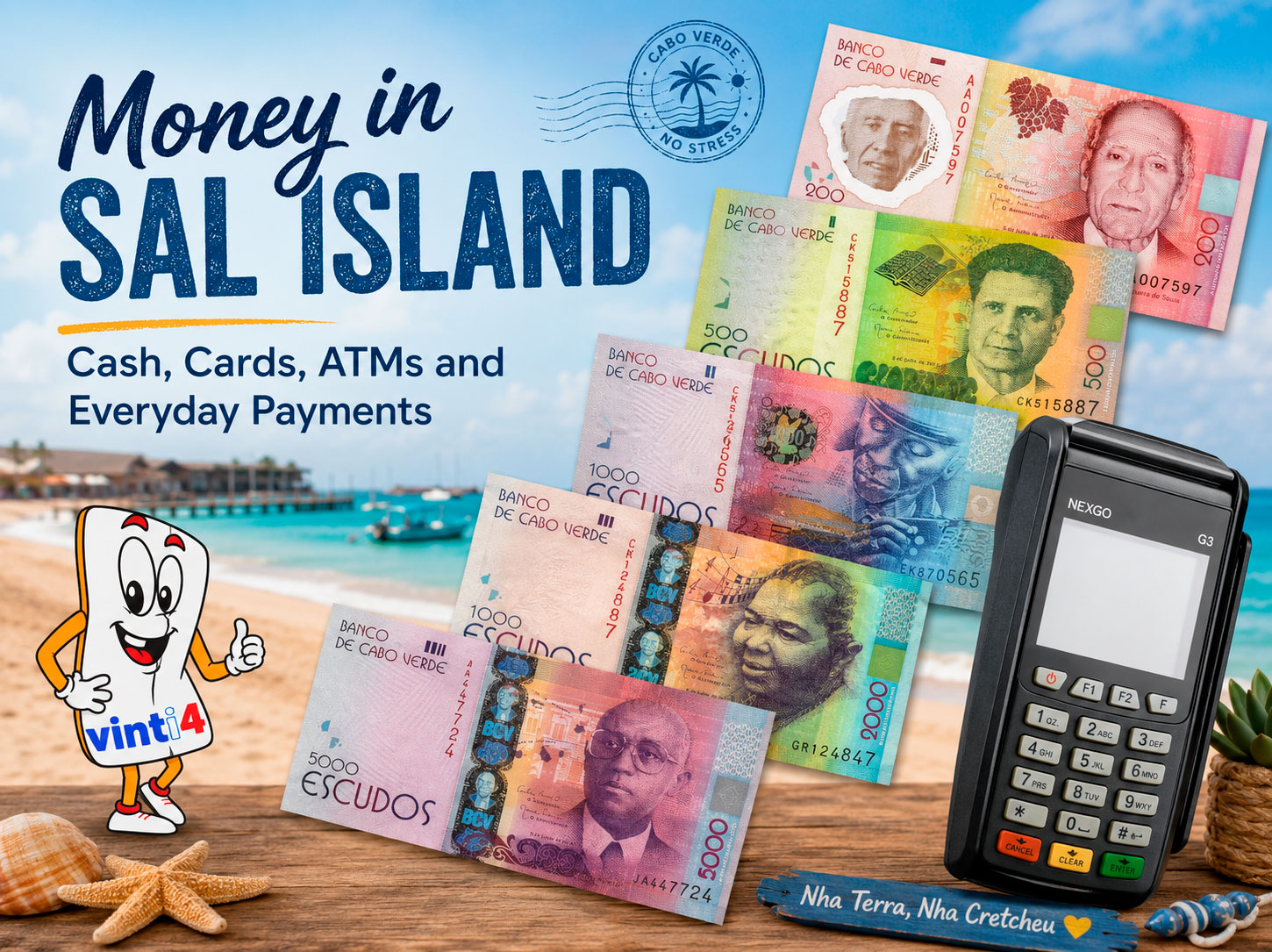
Paying for things in Sal Island is generally straightforward, but relying on only one payment method can create unnecessary inconvenience.
The official currency is the Cape Verdean escudo, usually written as CVE or shown locally with the symbol $. Euros are also accepted by many tourism-related businesses, particularly in Santa Maria, but that does not mean they are always the most practical option.
For most visitors, the best approach is simple: carry some escudos for everyday expenses and keep a working bank card available for larger or more formal payments.
In Sal, the safest payment plan is not cash or card. It is cash and card.
What currency is used in Sal Island?
Sal uses the Cape Verdean escudo, the national currency of Cabo Verde.
The escudo has a fixed exchange rate against the euro:
€1 = 110.265 CVE
For quick mental calculations, many businesses use the simpler reference of:
€1 ≈ 110 CVE
This makes prices relatively easy to understand for visitors from the eurozone.
For example:
- 550 CVE is approximately €5;
- 1,100 CVE is approximately €10;
- 2,200 CVE is approximately €20;
- and 5,500 CVE is approximately €50.
The fixed rate makes conversion easy, but it does not mean every business will apply exactly the same conditions when you pay directly in euros.
Can you pay in euros in Sal Island?
Yes, euros are accepted in many places, especially in Santa Maria and in businesses dealing regularly with tourists.
You may be able to pay in euros at:
- hotels and resorts;
- tourist restaurants;
- excursion agencies;
- vehicle rental companies;
- souvenir shops;
- and some supermarkets.
However, accepting euros is a convenience offered by the business, not a guarantee that every payment will be calculated exactly as you expect.
Some establishments may:
- use the rounded rate of €1 to 110 CVE;
- return change in Cape Verdean escudos;
- have difficulty changing large euro notes;
- or prefer escudos for smaller purchases.
Paying for a hotel or excursion in euros may be convenient. Trying to buy a bottle of water with a €50 note is a different matter.
Is it better to use euros or Cape Verdean escudos?
Escudos are generally better for normal daily spending.
They are especially useful for:
- taxis;
- small shops;
- local cafés and bars;
- market purchases;
- tips;
- small entrance fees;
- and inexpensive everyday transactions.
Euros can remain useful for larger tourism-related payments, particularly when the price has already been quoted in euros.
The most practical arrangement is usually:
- escudos for small and everyday expenses;
- card payments for suitable established businesses;
- and euros as an additional option rather than your only source of money.
It is useful to arrange that combination early in the trip without making every financial decision immediately after landing. Our guide to what not to do during your first 48 hours in Sal explains why starting with a modest amount of cash is usually more sensible than withdrawing or exchanging too much at once.
Are credit and debit cards widely accepted?
Cards are accepted by many established businesses in Sal, particularly in the main tourism areas.
You are more likely to be able to pay by card at:
- hotels and resorts;
- larger supermarkets;
- established restaurants;
- vehicle rental companies;
- tour operators;
- and larger tourist shops.
Card acceptance is less predictable at:
- small neighbourhood shops;
- local cafés;
- some taxis;
- market stalls;
- informal services;
- and small purchases where the seller may prefer cash.
Even when a card terminal is available, the payment may occasionally fail because of connectivity, terminal problems or incompatibility with a particular card.
Never assume that seeing a card terminal means your card is guaranteed to work.
Which cards are most useful?
International Visa and Mastercard cards are generally the most useful options for travellers.
However, acceptance can depend on:
- the issuing bank;
- the type of card;
- the payment network;
- the establishment’s terminal;
- and whether international transactions are enabled.
Before travelling, check that your card:
- can be used outside your home country;
- is enabled for cash withdrawals;
- has not reached its spending or withdrawal limits;
- and does not carry unusually high foreign-transaction fees.
Travelling with two cards from different accounts or providers can provide useful protection if one is blocked, lost or rejected.
Cards, emergency money and documentation should also be divided between secure places rather than carried together. These are among the practical items covered in our guide to what to pack for Sal Island and what you can leave at home.
Are there ATMs in Sal Island?
Yes. ATMs are available in Santa Maria, Espargos and other populated parts of the island.
In Cabo Verde, ATMs and many payment terminals belong to the national Vinti4 network.
International cards can be used at compatible Vinti4 machines, although successful withdrawals still depend on the card, issuing bank and available network connection.
ATMs are useful, but it is not wise to wait until you have no cash left before looking for one.
A machine may occasionally be:
- temporarily unavailable;
- out of cash;
- unable to process your particular card;
- or subject to withdrawal limits.
Withdraw money while you still have another payment option available.
What fees can appear at an ATM?
An international cash withdrawal may involve more than one type of charge:
- a fee applied by your own bank;
- a currency-conversion fee;
- a foreign-withdrawal fee;
- or a charge connected with the local ATM or payment network.
The total cost depends heavily on your card provider.
Before travelling, check:
- the fixed fee for withdrawing abroad;
- the percentage charged for currency conversion;
- the daily withdrawal limit;
- and whether your bank offers a travel-friendly account or card.
Repeated small withdrawals can become expensive if your bank charges a fixed fee each time.
Should you accept conversion into euros at an ATM or terminal?
Some ATMs or card terminals may offer to convert the payment into your home currency.
This is known as dynamic currency conversion.
The displayed amount may look convenient because it shows exactly how many euros will be charged, but the conversion rate may be less favourable than the rate used by your own card provider.
When given the choice, it is generally worth comparing the conditions carefully before accepting conversion.
Paying or withdrawing in the local currency — CVE — often allows your own bank or card network to perform the conversion instead.
How much cash should you carry each day?
There is no single correct amount.
You should carry enough for your likely daily needs, but not your entire holiday budget.
A sensible daily cash amount should cover:
- a taxi or two;
- small food and drink purchases;
- a simple meal;
- tips or minor entrance fees;
- and an unexpected expense if your card does not work.
Keep the rest of your money securely stored at your accommodation.
For most visitors, dividing money between:
- a wallet;
- secure accommodation storage;
- and a second card or emergency reserve
is safer than carrying everything together.
Keeping cash and valuables under control is part of the same common-sense approach discussed in our guide to how safe Sal Island generally feels for tourists.
Small notes are more useful than large ones
Large banknotes can be inconvenient for inexpensive purchases.
A taxi driver, café or small shop may not have enough change, particularly early in the day or after several customers have paid with large notes.
Try to keep a mixture of smaller notes for:
- taxis;
- drinks;
- small shops;
- tips;
- and minor purchases.
Use larger notes in supermarkets, established restaurants or other businesses more likely to have change available.
Should you exchange money before arriving?
You do not normally need to obtain a large quantity of Cape Verdean escudos before travelling.
Depending on your arrival arrangements, you can:
- bring euros and exchange some after arrival;
- withdraw escudos from an ATM;
- or combine both methods.
What matters is having a workable option for the first expenses of the trip.
If your airport transfer has not been prepaid, make sure you can pay for it without depending on finding a particular bank or exchange office immediately after landing.
The first transfer is easier when you already have the address of your accommodation, an agreed transport arrangement and an accessible payment method. Our article on what to expect when you land in Sal for the first time covers the practical beginning of the journey.
Where can you exchange money?
Currency exchange may be available through:
- banks;
- authorised exchange services;
- airport facilities;
- and some hotels.
Rates and commissions may differ, even though the Cape Verdean escudo has a fixed official relationship with the euro.
Before exchanging, confirm:
- the rate being applied;
- whether there is a commission;
- how much you will receive;
- and whether identification is required.
A fixed exchange rate does not automatically mean every exchange service is free.
Can you use dollars or pounds?
US dollars and British pounds are not as practical for direct everyday payments as euros.
They may need to be exchanged through a bank or authorised service before use.
If your home currency is not the euro, compare whether it is more economical to:
- withdraw escudos directly with your card;
- exchange your home currency in Cabo Verde;
- or convert some money into euros before travelling.
The best choice depends on the fees and exchange rates offered by your own bank or currency provider.
Do taxis accept cards?
You should not depend on being able to pay a normal taxi journey by card.
Some drivers or transfer companies may offer electronic payment, particularly for prearranged services, but cash remains the safer assumption for ordinary taxi journeys.
Before starting the trip:
- confirm the total fare;
- ask whether the price is per vehicle or per passenger;
- clarify whether waiting time is included;
- and confirm the accepted payment method.
Agreeing on the fare and payment method before departure avoids most misunderstandings.
Payment is only one part of choosing transport. Our guide to taxis, tours, rental cars and local transport in Sal explains which alternatives are most practical for everyday journeys and exploring the island.
Do restaurants accept cards?
Many established restaurants in Santa Maria accept cards, but smaller or simpler establishments may prefer cash.
Before ordering, check when:
- you do not have enough cash available;
- the restaurant appears particularly small or informal;
- you are outside the main tourist areas;
- or you plan to pay with a less common card.
A small card logo near the door is useful. A quick question before the meal is more useful.
Restaurant prices, tourist locations and the type of establishment can also affect how much you spend. Our guide to what travellers should realistically expect from food in Sal looks at quality, value and eating out in more detail.
What happens if your card is declined?
A declined payment does not necessarily mean there is insufficient money in the account.
Possible reasons include:
- international use being disabled;
- a fraud-prevention block;
- a daily spending limit;
- a temporary connection problem;
- terminal incompatibility;
- or an incorrect PIN.
If a card fails:
- Try again only after checking the amount and PIN.
- Ask whether another terminal or payment method is available.
- Use your second card or cash if necessary.
- Contact your bank through its official application or telephone number.
- Do not allow anyone to take the card away from your sight unnecessarily.
Should you inform your bank before travelling?
Some banks no longer require advance travel notifications, but unusual foreign transactions can still trigger security checks.
Before departure:
- confirm that international payments are enabled;
- check how to freeze or unblock the card;
- save the bank’s emergency contact details;
- install and test the banking application;
- and ensure you can receive any verification messages abroad.
Discovering that your bank sends security codes only to an inactive home number is better done before the restaurant bill arrives.
Reliable mobile access can be important for receiving verification messages or using a banking application. Our guide to Internet access, SIM cards and eSIMs in Sal Island explains the main connectivity options.
What should you do with leftover escudos?
Because the Cape Verdean escudo is mainly used within Cabo Verde, it may be difficult or inconvenient to exchange after leaving the country.
During the final days of the trip:
- reduce unnecessary ATM withdrawals;
- use remaining cash for meals, taxis or small purchases;
- keep enough for the airport transfer and final expenses;
- and ask an authorised exchange service about converting larger leftovers.
A few remaining notes can be kept for a future visit. A large unused holiday budget is less charming as a souvenir.
Common money mistakes in Sal Island
Relying only on cards
Cards are useful, but they are not accepted everywhere and terminals do not work perfectly at all times.
Carrying only euros
Euros may be accepted, but escudos are more practical for daily life and small purchases.
Withdrawing very small amounts repeatedly
Fixed bank fees can make several small withdrawals more expensive than one planned transaction.
Accepting every currency conversion automatically
The convenient amount displayed in euros may not represent the most favourable conversion.
Carrying only large notes
Small businesses and taxi drivers may not always have enough change.
Keeping all cards and cash together
Losing one wallet should not remove every possible way of paying.
Waiting until the last moment to find an ATM
A temporary machine or network problem becomes more serious when you have no cash alternative.
A practical payment plan for Sal
Before travelling
- Check foreign-payment and withdrawal fees.
- Enable international use on your cards.
- Bring at least two payment options.
- Save your bank’s emergency contact details.
- Prepare enough money for the arrival and transfer.
After arriving
- Obtain a modest amount of escudos.
- Test your main card with an ordinary purchase or withdrawal.
- Keep some small notes available.
- Store backup money separately.
- Check the accepted payment method before important purchases.
During the trip
- Use escudos for small daily expenses.
- Use cards where they are accepted reliably.
- Keep euros as an additional option.
- Monitor bank fees and transaction notifications.
- Avoid carrying more cash than you need that day.
Looking for useful services during your stay?
Browse banks, practical services and other useful local resources across Sal Island through our directory.
In summary
The easiest way to handle money in Sal Island is to combine Cape Verdean escudos, a working bank card and a small euro reserve.
Escudos are the most practical option for taxis, small shops, tips and everyday purchases. Cards are widely useful in hotels, supermarkets, established restaurants and tourism businesses, but they should not be your only payment method.
ATMs are available through the Vinti4 network, although fees, withdrawal limits and compatibility depend partly on your own bank and card.
Before travelling, check international use, withdrawal charges and verification methods. Once on the island, keep some smaller notes, confirm payment methods before important purchases and store your backup money separately.
Carry enough cash to stay flexible, but not enough to turn your wallet into the most valuable attraction on the island.
With that simple balance, everyday payments in Sal are normally easy to manage.