

Getting around Sal Island is not particularly complicated, but it does not work like transport in a large European city.
There is no dense public transport network, no underground system and no need to spend the entire holiday moving from one side of the island to the other.
Instead, most travellers rely on a practical combination of walking, taxis, organised tours, shared local transport and occasional vehicle rental.
The best option depends less on which type of transport is theoretically “best” and more on where you are staying, how long you have and what you actually want to do. Your accommodation can determine whether walking covers most daily needs or whether every meal, beach visit and evening requires transport, as explained in our guide to where to stay in Sal Island.
In Sal, good transport planning is not about moving more. It is about avoiding unnecessary movement.
Is Sal Island easy to get around?
Generally, yes.
Sal is relatively compact, and many visitors stay in or around Santa Maria, where the beach, restaurants, shops, bars and several activity providers are close enough to reach on foot.
The rest of the island requires more planning, but distances are manageable by taxi, tour or rental vehicle.
The main difficulty is not the size of Sal. It is assuming that every location is connected by frequent public transport or that you can improvise every journey in the same way you would in a major city.
Once you understand that transport works through a mixture of private and informal options, the island becomes much easier to navigate.
Walking around Santa Maria
If you are staying in central Santa Maria, walking will probably cover a large part of your daily routine.
You can usually reach:
- the main beach;
- restaurants and cafés;
- shops and supermarkets;
- bars and evening venues;
- the pier and central streets;
- many excursion meeting points.
This is one of the reasons Santa Maria works so well as a base. You do not need transport every time you want to eat, go to the beach or take a short walk through town.
Its streets, distances and everyday atmosphere are easier to understand once you know what Santa Maria is really like beyond the postcard.
However, walking is not a realistic way to explore Sal as a whole.
Outside the built-up areas, distances become less practical, shade is limited and the combination of sun and wind can make a walk feel longer than expected.
Walking is excellent within Santa Maria. It is not an island-wide transport strategy.
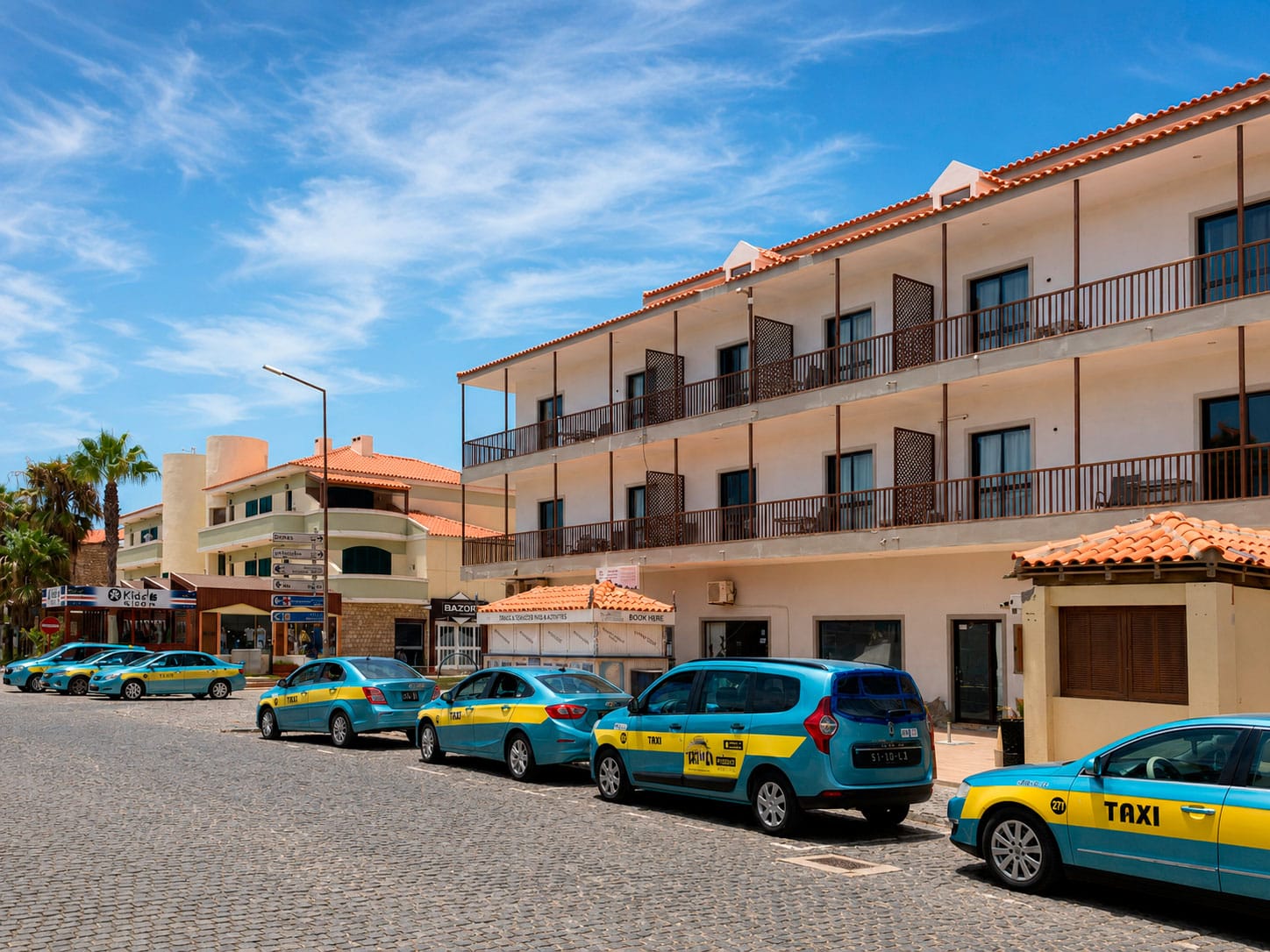
Taxis: the easiest option for occasional journeys
Taxis are one of the simplest ways to move around Sal, particularly for visitors based in Santa Maria.
They work well for:
- airport transfers;
- short journeys around Santa Maria;
- going to restaurants or hotels farther from the centre;
- occasional visits to another part of the island;
- evening journeys when walking is no longer convenient;
- travellers who do not want to drive.
Taxis are usually easy to find around the airport, hotels and the busier parts of Santa Maria. Your accommodation or restaurant can often call one when needed.
Confirm the price before leaving
Do not assume every journey uses a visible meter or a single universal fare.
It is sensible to confirm the price with the driver before setting off, particularly for:
- airport transfers;
- longer journeys;
- waiting time;
- return journeys;
- trips involving several stops.
This avoids confusion later and gives you a clearer idea of whether a taxi remains the most economical option for the day you have planned.
Cash is often the safest assumption for ordinary taxi journeys, so it is useful to understand cash, cards, ATMs and everyday payments in Sal before depending entirely on a bank card.
When taxis stop being the best solution
Using a taxi occasionally is convenient. Using several taxis every day for an entire week may become less efficient.
If you intend to visit multiple places, stop repeatedly or change plans throughout the day, it may make more sense to:
- agree on a half-day or full-day arrangement with a driver;
- book an organised tour;
- or rent a vehicle for part of the trip.
Taxis work best when they solve individual journeys rather than holding the entire holiday together.
Alugueres and shared local transport
Cape Verde also uses shared passenger vans commonly known as alugueres or carrinhas.
They are an inexpensive form of informal public transport used mainly by local residents and workers travelling between towns and populated areas.
For some visitors, they can be useful for straightforward journeys between places such as Santa Maria and Espargos.
However, they do not normally operate like a formal urban bus network with:
- clearly displayed timetables;
- frequent departures throughout the entire day;
- tourist routes covering multiple attractions;
- guaranteed connections.
Departure times may depend on demand, the route and the time of day. Pick-up and drop-off points may also be less obvious to someone unfamiliar with the island.
Shared transport is therefore best suited to travellers who:
- want to keep costs low;
- are not in a hurry;
- have a simple destination;
- are comfortable asking locally how the route works;
- do not need door-to-door service.
It is less useful for a sightseeing day involving several remote stops.
An aluguer can be cheap and practical. It is not a guided tour with a timetable wearing local clothes.
This less formal approach to schedules is part of what tourists often misunderstand about life in Sal. Flexibility can be practical, but it should not be confused with the predictability of a city bus network.
Organised tours: the easiest way to see several places
For many first-time visitors, an organised island tour is the simplest way to understand Sal beyond Santa Maria.
Tours usually combine several well-known locations into one route, removing the need to organise transport between each stop.
They make particular sense if:
- you are staying only a few days;
- you do not want to drive;
- you want a general introduction to the island;
- you prefer someone else to organise the route;
- you want transport and explanations together.
What a tour gives you
- a planned route;
- transport between stops;
- fewer logistical decisions;
- a quick overview of Sal;
- local context when the guide is good.
What a tour takes away
- control over timing;
- freedom to stay longer in one place;
- the possibility of changing the route spontaneously;
- a more personal rhythm.
That does not make tours inferior. It simply means they work best when your priority is clarity and convenience rather than complete freedom.
One well-chosen island tour can be enough to understand the geography of Sal and decide whether you want to revisit any location independently later.
How many excursions make sense also depends on the length of the holiday. Our guide to how many days are enough to enjoy Sal Island explains why filling every day with transport and tours is rarely necessary.
Renting a car in Sal
A rental car gives you control over your schedule, but it is not automatically necessary.
It becomes more useful when:
- you are staying outside central Santa Maria;
- you want to explore over several days;
- you prefer stopping wherever you choose;
- you are travelling with several people;
- you want to revisit places without following a tour timetable.
It may not be worth the expense when:
- you are staying mainly in Santa Maria;
- you only want one general island excursion;
- you plan to spend most days at the beach;
- you do not enjoy driving in unfamiliar places;
- the vehicle would remain parked most of the time.
Renting a car should solve a real transport need, not an imaginary one created before the holiday begins.
For a more detailed comparison of costs, independence and realistic usage, read our guide to whether you really need to rent a car in Sal Island.
Normal car or 4×4?
The main roads connecting Santa Maria, Espargos, the airport and other populated areas can generally be approached with a conventional vehicle.
Some coastal locations and interior tracks are rougher, less clearly marked or better suited to vehicles designed for uneven terrain.
Before leaving paved roads, check:
- whether the rental agreement allows it;
- whether the insurance covers unpaved tracks;
- whether the route is suitable for the vehicle;
- whether you have reliable directions;
- whether the location is genuinely accessible independently.
A vehicle that looks adventurous does not automatically make every track a good idea.
Before accepting a rental vehicle
- Photograph existing damage.
- Check the fuel level.
- Confirm the insurance conditions.
- Ask what assistance is available in case of a problem.
- Check whether there are restrictions on off-road use.
- Make sure you understand the return conditions.
Do not leave passports, phones, cameras or bags visible inside a parked vehicle.
Scooters, bicycles and electric bikes
Scooters and bicycles can be useful for shorter journeys, but the island’s conditions need to be considered.
The wind can be strong, shade is limited and some routes are less comfortable than they appear on a map.
A bicycle or electric bike may work well for:
- moving around Santa Maria;
- short recreational rides;
- reaching nearby beaches or accommodation;
- travellers comfortable with sun and wind exposure.
They are not necessarily the best choice for crossing large parts of the island or following unfamiliar roads without preparation.
Wear appropriate protection, take water and avoid assuming that a short distance on the map will feel equally short in strong wind.
The effect of wind varies by season and location, so it is worth checking Sal Island’s climate and wind throughout the year before planning long rides or exposed journeys.
Buggies and quads are usually activities, not general transport
Buggy and quad tours are among the popular adventure activities available in Sal.
They can be an entertaining way to experience dunes, tracks and open landscapes, but they should not automatically be considered substitutes for a rental car.
Most visitors use them as:
- guided excursions;
- off-road experiences;
- short-term recreational rentals;
- ways to reach specific landscapes as part of an organised route.
They are generally less practical for ordinary daily movements, carrying luggage, going out for dinner or transporting a family comfortably.
A buggy can be part of the holiday. It does not need to become the holiday’s public transport system.
Getting from the airport to Santa Maria
Most international visitors arriving at Amílcar Cabral International Airport continue to Santa Maria.
The usual options are:
- a transfer included by a hotel or tour operator;
- a pre-booked private transfer;
- a taxi from the airport;
- a rental vehicle collected on arrival.
If your transport has already been arranged, keep the company name, contact number and meeting instructions accessible offline.
If you take a taxi, confirm the fare before leaving the airport.
For more detail about the arrival itself, read our guide to what to expect when you land in Sal for the first time.
Which transport option is right for your trip?
| Option | Best for | Main advantage | Main limitation |
|---|---|---|---|
| Walking | Central Santa Maria | Free and convenient | Not suitable for exploring the whole island |
| Taxi | Occasional journeys | Direct and easy | Costs accumulate with frequent use |
| Aluguer | Simple low-cost routes | Affordable | Less predictable and not tourist-oriented |
| Organised tour | First visits and short stays | Route and transport are organised | Limited freedom over timing |
| Rental car | Flexible multi-day exploration | Complete control of your schedule | Cost, insurance and responsibility |
| Bike or e-bike | Short local journeys | Flexible and enjoyable | Wind, heat and limited range |
| Buggy or quad | Adventure activities | Fun access to off-road scenery | Not practical as everyday transport |
Simple recommendations by type of stay
A short stay in Santa Maria
Walk for daily life, use taxis when necessary and book one island tour if you want a general overview.
A week focused mainly on the beach
You probably do not need a car for the entire stay. Combine walking, occasional taxis and one or two organised excursions.
A longer stay with independent exploration
Consider renting a car for selected days rather than automatically paying for it throughout the whole trip.
A family holiday
Private transfers, taxis and organised tours may be easier than relying on informal transport, particularly when carrying beach equipment or travelling with younger children.
A low-budget trip
Stay centrally, walk whenever practical, learn how shared transport works and reserve taxis for journeys where they genuinely add value.
Common transport mistakes in Sal
- Renting a car for the entire holiday without calculating how often it will actually be used.
- Using individual taxis for a day involving many separate stops.
- Expecting shared transport to follow a precise tourist timetable.
- Treating every unpaved track as suitable for a normal rental car.
- Assuming walking is practical everywhere because the island looks small.
- Booking too many tours and spending the whole trip following someone else’s schedule.
- Failing to agree taxi prices or rental conditions in advance.
Do you need to choose only one option?
No. In fact, most travellers are better served by combining several.
A sensible trip might look like this:
- walking around Santa Maria;
- using a taxi for an evening or airport journey;
- taking one organised island tour;
- renting a vehicle for one or two independent days.
This is often more efficient than choosing one transport method in advance and forcing every day to fit it.
Ready to explore more of Sal Island?
Browse island tours, buggy routes, boat trips, water sports and other experiences across Sal Island through our local directory.
In summary
Getting around Sal Island is generally straightforward once you stop expecting big-city transport.
Walking works well in Santa Maria. Taxis are convenient for occasional journeys. Shared alugueres are economical for certain routes but less predictable. Tours provide an easy introduction to the island. Rental vehicles offer freedom when you genuinely intend to use it.
Bicycles, scooters, buggies and quads can also be useful or enjoyable, but each serves a different purpose.
The best transport plan is rarely the most complicated one.
Choose each journey according to what you are doing that day, rather than choosing one vehicle for the entire holiday “just in case”.
When transport matches the actual rhythm of your trip, Sal becomes easier, cheaper and much more pleasant to explore.