

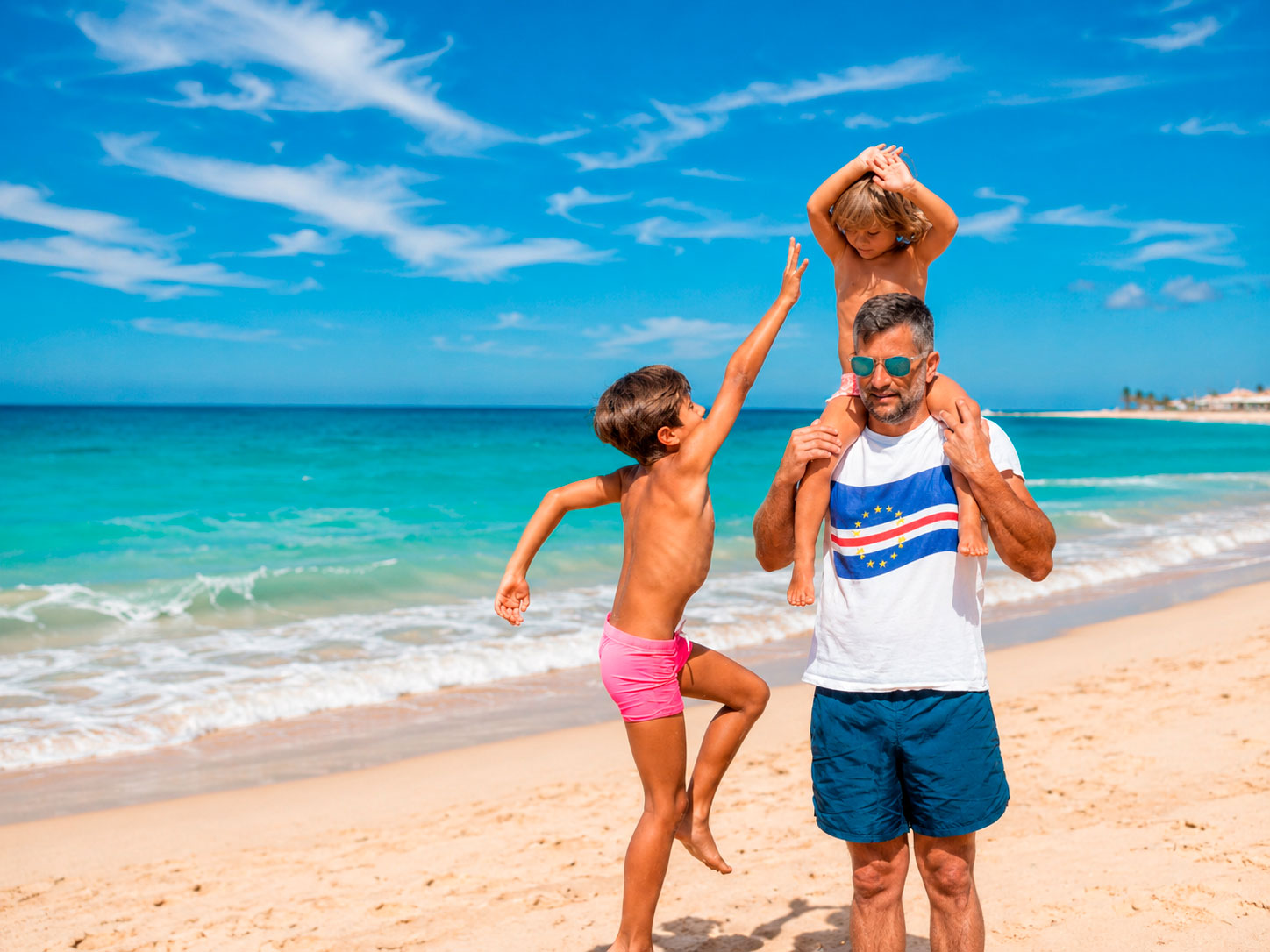
Travelling to Sal Island with children is generally manageable, especially for families looking for beach time, warm weather and a holiday that does not require constant sightseeing.
The island is relatively small, Santa Maria offers most of the services visitors need, and many hotels and resorts are designed with families in mind.
However, Sal is not a destination where every beach is automatically calm, every pavement is suitable for a pushchair or every excursion works equally well for young children.
A successful family trip depends less on filling the days with activities and more on choosing the right accommodation, beach, transport and daily rhythm.
Sal can be easy with children, but the easiest version of the trip is usually the one planned around their real needs rather than an ambitious itinerary.
Quick answer: is Sal Island good for families?
Yes, Sal can be a good family destination, particularly for families who enjoy:
- beach holidays;
- hotel or resort facilities;
- short excursions;
- warm weather;
- and relatively simple daily plans.
It may be less suitable for families expecting:
- a large number of theme parks or organised attractions;
- constant indoor entertainment;
- perfectly calm sea conditions every day;
- or the range of specialist services available in a major city.
Sal works best when the beach, pool, accommodation and a few selected activities provide most of the holiday.
This means that families who are comfortable with a slower and less attraction-driven trip often adapt more easily. Our article on whether Sal Island is worth visiting without water sports explains why the island can still work well when the holiday is based on beaches, walks, small outings and unstructured time.
Which ages are best suited to Sal?
Sal can work for children of different ages, but the practical experience changes considerably.
Babies and toddlers
The main considerations are:
- shade and sun exposure;
- access to familiar food and hygiene products;
- sleep routines;
- pushchair-friendly routes;
- car seats;
- and proximity to pharmacies or medical assistance.
A resort or well-equipped apartment close to everyday services may be easier than isolated accommodation.
Primary-school children
This age often works particularly well because children can enjoy:
- the beach and pool;
- short island tours;
- boat trips suited to their age;
- simple wildlife experiences;
- and time outdoors without needing constant organised entertainment.
Teenagers
Teenagers may enjoy:
- surfing or kitesurfing lessons;
- snorkelling;
- buggy or quad experiences where age rules allow;
- boat activities;
- and greater independence around a resort or central Santa Maria.
The destination may feel limited to teenagers who need shopping centres, amusement parks or a constantly changing programme.
Where should families stay?
For most families, the easiest choices are:
- central or quieter parts of Santa Maria, where shops, restaurants, pharmacies and beaches are nearby;
- or a family-oriented resort, where pools, meals, entertainment and services are concentrated in one place.
The wider comparison between Santa Maria, resort areas, Murdeira and other possible bases is covered in our guide to where to stay in Sal Island.
Central Santa Maria
Central Santa Maria may suit families who want:
- restaurants within walking distance;
- easy access to supermarkets and pharmacies;
- more independence from the hotel;
- and short journeys during the day.
The main disadvantages may include street noise, busier surroundings and less space than a larger resort.
Quieter parts of Santa Maria
A quieter area can offer:
- less evening noise;
- larger apartments;
- a more residential atmosphere;
- and calmer routines.
Check the real walking distance to the beach and centre, especially when travelling with young children.
Resorts outside the centre
Resorts may work well for families who prioritise:
- swimming pools;
- children’s clubs;
- organised entertainment;
- buffet meals;
- and fewer daily logistics.
The trade-off is greater dependence on taxis or hotel transport when visiting Santa Maria.
What should families check before booking accommodation?
- Check the real distance to the beach.
- Confirm whether the room can comfortably accommodate everyone.
- Ask whether a cot or extra bed is available.
- Check whether the pool has a children’s area or appropriate depth.
- Confirm whether balconies, stairs and windows are suitable for young children.
- Check whether the property has a kitchen or fridge.
- Read recent comments about noise.
- Ask whether Wi-Fi reaches the room.
- Check access to supermarkets, pharmacies and taxis.
- Confirm whether airport transfers provide child seats.
A large room and reliable daily setup often matter more than a long list of hotel extras.
Which beaches are easiest with children?
Santa Maria Beach is normally the most practical choice for families.
Its advantages include:
- easy access from many hotels and apartments;
- restaurants and cafés nearby;
- toilets and services in the surrounding area;
- places to buy drinks or food;
- and the possibility of leaving the beach quickly when children become tired.
However, no beach in Sal should be assumed to have calm water every day.
Wind, waves and currents change, so parents should:
- observe the sea before children enter;
- follow warning flags and local advice;
- keep young children within immediate reach;
- and avoid inflatable toys that can drift in the wind.
Beach conditions vary considerably around the island. Our comparison of the best beaches in Sal Island and what each one is suited to can help families distinguish between practical swimming areas, exposed water-sports beaches and more isolated coastal locations.
What about Murdeira?
Murdeira Bay can feel quieter and more sheltered when conditions are suitable.
It may appeal to families looking for a calmer coastal setting, but services are more limited and transport normally needs more planning.
Which beaches require more caution?
More exposed beaches such as Ponta Preta, Kite Beach and remote coastal areas should not automatically be treated as swimming beaches for children.
They may be better suited to:
- walking;
- watching water sports;
- photography;
- or short scenic visits.
Sun, wind and dehydration
The wind can make Sal feel cooler than it really is.
This can be misleading because children may remain in direct sun for long periods without feeling excessively hot.
Families should use:
- high-protection sunscreen suitable for children;
- secure hats or caps;
- ultraviolet-protective swimwear;
- light clothing that covers the skin when needed;
- and regular drinking breaks.
Do not rely only on children saying that they feel thirsty or hot.
Plan shade breaks and avoid making the middle of the day the most active part of the schedule.
The combination of sun, seasonal wind and exposed beaches is explained more fully in our guide to Sal Island’s climate and wind throughout the year.
Natural shade is limited
Many beaches in Sal have little natural shade.
Hotels, beach clubs and some parts of Santa Maria may offer umbrellas or covered areas, but remote beaches should not be approached with the expectation of finding shade easily.
When leaving the main tourist areas, carry:
- enough drinking water;
- sun protection;
- a light cover-up;
- and a realistic plan for how long the family will remain outside.
Food with children
Santa Maria offers a reasonable variety of restaurants, cafés, supermarkets and bakeries.
Families can usually find simple options such as:
- rice;
- pasta;
- grilled chicken;
- fish;
- chips;
- sandwiches;
- fruit;
- yoghurt;
- and familiar breakfast items.
Availability and preparation may not always match what children eat at home.
For younger or selective eaters, it is useful to:
- choose accommodation with a fridge or kitchen;
- keep simple snacks available;
- check restaurant menus before sitting down;
- and avoid waiting until children are exhausted before looking for food.
Families wanting a clearer idea of restaurant variety, simple dishes and realistic standards can read our guide to what travellers should expect from food in Sal Island.
What about baby food, formula and nappies?
Basic child-care products can be found in larger supermarkets and pharmacies, particularly in Santa Maria and Espargos.
However, specific brands, sizes or specialist products may not always be available.
Parents of babies should bring enough of any essential or difficult-to-replace product, including:
- special formula;
- prescription food;
- allergy-safe products;
- preferred nappies;
- and familiar medication.
Ordinary supplies can often be replaced. A particular product that a child depends on should not be left entirely to chance.
Drinking water
Families should arrange reliable drinking water from the beginning of the trip.
For most visitors, this means bottled or appropriately treated water.
Keep enough water available for:
- the accommodation;
- beach time;
- excursions;
- and journeys where shops may not be nearby.
A reusable bottle is helpful, but it should be filled from a source the family considers safe.
Our practical guide to drinking tap water in Sal without overdramatising the issue explains why bottled or reliably filtered water is generally the simplest option for short family stays.
Getting around with children
Sal is not a large island, but transport becomes more important when every journey includes bags, sun, tired children and waiting time.
Walking
Central Santa Maria is relatively easy to explore on foot, but not every street has smooth pavements.
Families using a pushchair may encounter:
- uneven surfaces;
- sand;
- unfinished pavements;
- high kerbs;
- and routes with little shade.
A lightweight, robust pushchair may be more practical than a delicate model designed mainly for smooth urban surfaces.
Taxis
Taxis can simplify:
- airport transfers;
- evening journeys;
- trips with tired children;
- and visits outside Santa Maria.
Confirm the total fare and the availability of suitable child restraints before the journey.
Do not assume that every ordinary taxi carries a child seat.
Rental cars
A rental car may make sense for families planning several independent trips.
Before booking, confirm:
- whether child seats are available;
- whether they match the child’s age and size;
- the condition of the restraint;
- the total rental cost;
- and whether the vehicle has enough luggage space.
For a mainly beach-based stay in central Santa Maria, taxis and selected tours may be easier than renting a car for the entire holiday.
Our guide to getting around Sal by taxi, tour, rental car and local transport compares the main alternatives and the amount of planning each one requires.
Airport transfers with children
The journey from the airport to Santa Maria is relatively short, but it should still be organised in advance when travelling with babies or young children.
Confirm:
- where the driver will meet you;
- the total price;
- whether a child seat is provided;
- and whether the vehicle can carry the luggage and pushchair.
A transfer described as “family friendly” should still be asked what that means in practical terms.
Which excursions work well for families?
Family suitability depends on the children’s ages, attention span and tolerance for heat or vehicle time.
Possible options include:
- a shorter island tour;
- a private tour with flexible stops;
- a carefully selected boat trip;
- a visit to Pedra de Lume;
- short coastal stops;
- or age-appropriate water activities.
A private tour may cost more but can offer:
- shorter stops;
- flexible meal times;
- space for luggage or a pushchair;
- and the possibility of ending early.
Questions to ask before booking an excursion
- How long is the total activity?
- How much time is spent inside the vehicle?
- Are child seats available?
- Is there shade?
- Are toilets available?
- Is food included?
- What is the minimum age?
- Are life jackets available in children’s sizes?
- Can the family leave early if necessary?
- Are entrance fees included?
An activity being advertised to families does not mean it suits every child or every age.
Boat trips with children
Boat trips can be enjoyable, but families should check:
- the duration;
- sea conditions;
- shade on board;
- toilet availability;
- life-jacket sizes;
- food and drink;
- and the possibility of seasickness.
Bring a light wind-resistant layer because the air can feel cooler on the water.
For children prone to motion sickness, discuss suitable preparation with a healthcare professional before travelling.
Buggy, quad and off-road activities
These activities may have minimum-age, height or seating restrictions.
They can also involve:
- dust;
- wind;
- strong sun;
- rough movement;
- and prolonged exposure outdoors.
Confirm the rules directly with the operator rather than assuming that a child can participate because there appears to be a spare seat.
Swimming pools and resort safety
Hotels and resorts vary considerably in pool design and supervision.
Before booking, check:
- whether there is a separate children’s pool;
- the depth of the main pool;
- whether lifeguards are present;
- whether pool areas are fenced;
- and whether balconies or terraces open directly towards the pool.
Do not assume that a family resort provides continuous supervision.
Parents remain responsible for monitoring children around water.
Health, medication and pharmacies
Bring enough regular medication for the entire trip and keep essential items in hand luggage.
A small family medical kit might include:
- the pain or fever medication normally used by the family;
- plasters and antiseptic wipes;
- rehydration salts;
- treatment already recommended for minor stomach problems;
- allergy medication where appropriate;
- after-sun treatment;
- and a thermometer.
Do not give children unfamiliar medication without professional guidance.
Before departure, make sure travel insurance covers every family member and understand where to seek medical assistance if needed.
What should families pack?
Useful family items include:
- children’s sunscreen;
- ultraviolet-protective swimwear;
- secure sun hats;
- reusable water bottles;
- regular medication;
- simple snacks;
- a lightweight pushchair where needed;
- familiar comfort items;
- and a light layer for evenings or boat trips.
For babies, also consider:
- enough formula or specialist food;
- preferred nappies for the first days;
- a portable changing mat;
- and any sleep-related item that helps maintain routine.
A more complete clothing, footwear, medication and beach checklist is available in our guide to what to pack for Sal Island and what you can leave at home.
How much should you plan each day?
Families usually enjoy Sal more when the schedule contains one main plan rather than several linked activities.
A realistic day may include:
- beach or pool time in the morning;
- lunch and rest;
- a short walk or simple activity later;
- and an early or flexible dinner.
Trying to combine an island tour, beach visit, restaurant reservation and evening activity may create more fatigue than enjoyment.
With children in Sal, one successful plan is often better than three plans completed badly.
What happens when children become bored?
Sal does not offer endless organised stimulation.
Children who enjoy:
- water;
- sand;
- simple outdoor play;
- short adventures;
- and repeated routines
may settle into the island very easily.
Children who expect a new attraction every few hours may need more deliberate planning from their parents.
Bring a few compact activities for:
- restaurant waits;
- quiet afternoons;
- flight delays;
- and periods when the weather or energy level changes.
Common mistakes families make
Choosing accommodation only by the pool photograph
Location, noise, room layout and access to food may matter more over the full week.
Assuming every beach is calm
Sea conditions vary by location and day.
Planning too many excursions
Long vehicle journeys and repeated early starts can quickly become tiring.
Waiting too long to organise meals
Hungry children rarely become more flexible while adults compare restaurant menus.
Underestimating the sun because of the wind
Children can burn or dehydrate even when the air feels comfortable.
Assuming child seats will automatically be available
Confirm restraints with transfer companies, taxis, rental firms and tour operators.
Bringing no familiar essentials
Basic products are available, but exact brands and specialist items may not be.
Expecting the destination to entertain children continuously
Sal works better for families comfortable with beach time, repetition and simpler days.
Who is Sal most likely to suit as a family destination?
Sal may suit families who want:
- a warm beach holiday;
- a resort or apartment-based stay;
- simple excursions;
- outdoor time;
- and a relaxed schedule.
It may be less suitable for families who require:
- large amusement parks;
- a wide range of indoor attractions;
- highly specialised shopping or healthcare;
- or a different major activity every day.
A practical family plan for one week
- Day 1: arrival, accommodation and a short walk.
- Day 2: beach or pool close to the accommodation.
- Day 3: short island tour or selected family excursion.
- Day 4: unstructured rest day.
- Day 5: boat trip, water activity or another beach, depending on age and conditions.
- Day 6: Santa Maria, shopping and a relaxed meal.
- Day 7: flexible final day and departure preparation.
This is not a compulsory itinerary. Its main value is the space between activities.
Looking for family-friendly things to do?
Explore island tours, boat trips, natural attractions and activities for different ages across Sal Island through our local directory.
In summary
Sal Island can work very well for families, especially those looking for beaches, warm weather and a relatively simple holiday.
The main practical considerations are:
- choosing accommodation that reduces daily travel;
- checking beach and pool conditions;
- protecting children from sun and dehydration;
- confirming child seats and age limits;
- bringing familiar medication and essential products;
- and avoiding an overloaded itinerary.
Santa Maria is generally the easiest base for independent families, while a well-equipped resort may suit those wanting most services in one place.
Sal does not need to provide a major attraction every day. For many children, the combination of beach, pool, space and a few carefully chosen experiences is enough.
The best family holiday in Sal is not the one with the fullest programme. It is the one in which everyone still has enough energy to enjoy the next day.